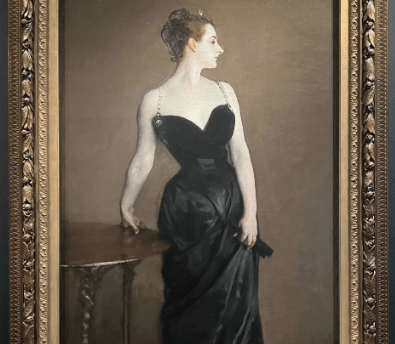
The Painting of Madame X
Words by: Rachelle Sitompul
Art by: Jennifer Chen
When you walk through a gallery and your eyes meet those of a painted woman, do you ever wonder who she really was? What were her thoughts in that moment, standing so still? What happened after the brush was set down and the paint dried? Did she laugh easily? Did she fear anything? Did she ever wish to disappear?
One woman invites such questions more than most: the subject of John Singer Sargent’s Portrait of Madame X. The painting was first unveiled at the Paris Salon, but wasn’t titled with her real name. But everyone in Paris society recognised the Parisian Virginie Amelie Avegno Gautreau. A porcelain-skinned woman stands poised against a hazy brown background. Her profile is serene; her jet-black dress, with delicate gold straps, clings to her form with understated elegance. Today, the portrait reads as classic. But in 1884, it was viewed as catastrophic.
Insufficiently dressed, vulgar and gauche. The painting was deemed too provocative for the public at the time. It wasn’t just the plunging neckline or the now-repainted fallen strap that shocked viewers, it was the perceived vulgarity of the whole thing. The backlash was swift and brutal. She was reduced to a symbol of vanity, seduction and arrogance. Critics dismissed her as merely a socialite with pale skin and daring posture. History froze her in that narrative.
But that’s not the whole story. That’s not her story.
Born in New Orleans in 1959 to a French Creole family, her father died during the American Civil War. At eight, her mother took her to live and be educated in Paris. There, she became a figure. She didn’t just enter the room, she commanded it. Not for her intellect, though she had one. Not for her resilience, though it was quiet and real. She was admired for her beauty, yes, but also for how she wore it, how she styled herself, how she carried power in a world that allowed women very little.
Amelie was not just Madame X, nor merely a socialite. Amelie was a mother. A wife. A woman who lived through war and migration, who navigated the sharp expectations of French high society while trying to maintain her individuality. She may have been admired for her looks, but what about her mind? Her choices? Her silences?
This wasn’t a hidden sketch or stolen likeness, this was a collaboration. She agreed to pose. She chose the dress, she decided how she shaped her image. This was, in many ways, her version of control: to be seen, but on her terms.
After the scandal, she chose to live quietly. But her retreat wasn’t defeat. Perhaps it was peace. Perhaps it was power. That, too, is a kind of agency.
Amelie was more than a frame could hold, a woman who dared to define herself in a world that preferred women silent, smiling and soft. And when that world turned on her, she simply stepped away.
Sometimes, leaving quietly is the loudest thing a woman can do.
 Esperanto Magazine