Words by: Shabnam Sidhu
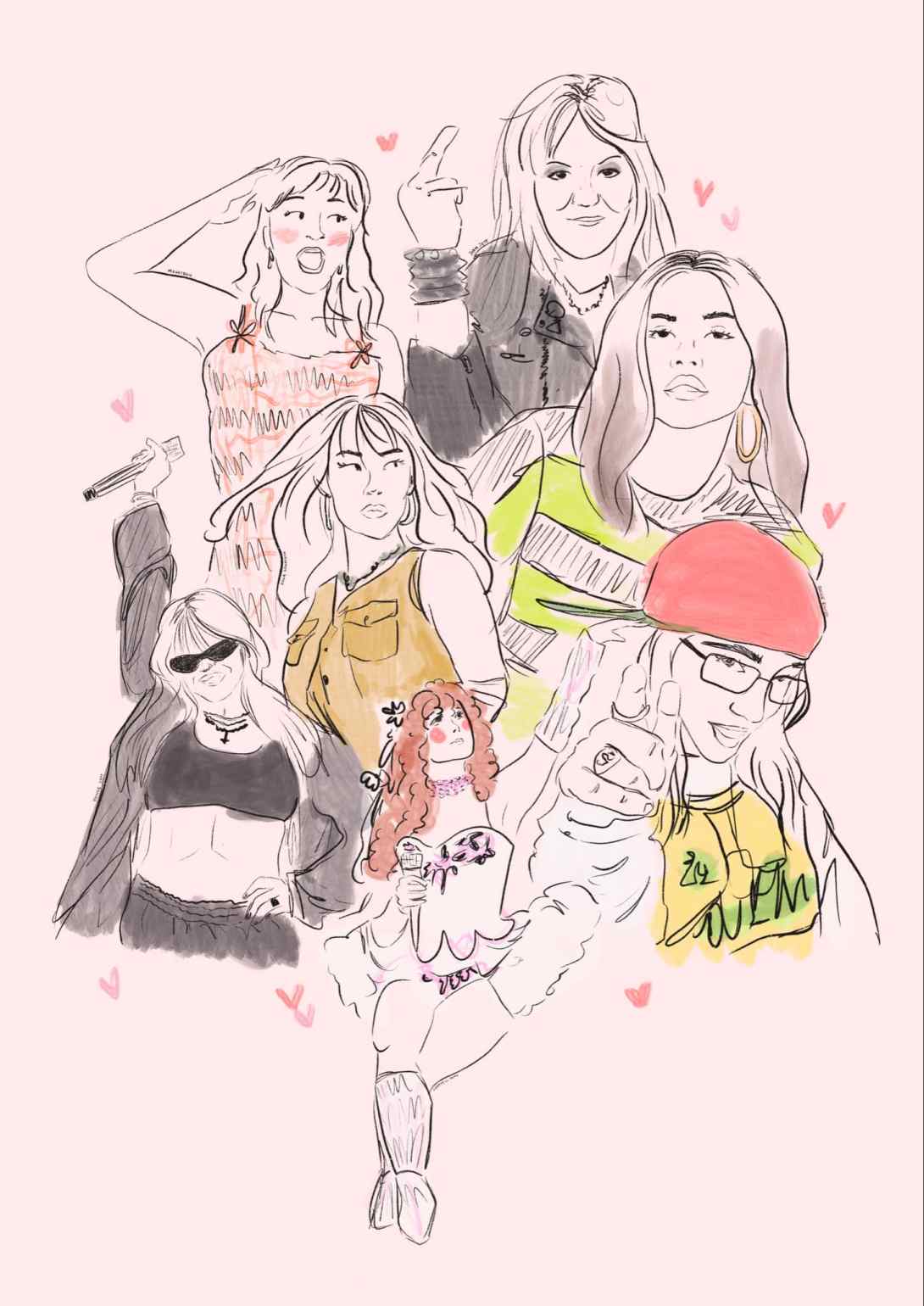
Art by: Evelyn Johnson
This was never the way I planned, not my intention…
I was 12, belting out the lyrics to Katy Perry’s ‘I Kissed a Girl’, curious about what Cherry Chapstick off someone else’s lips would taste like. I thought to myself, I would kiss a girl, but I would never do anything more than that.
At 15, I watched the music video for Hayley Kiyoko’s ‘Girls Like Girls’. I remember replaying the line ‘girls like girls like boys do, nothing new’ in my head over and over again and feeling a sense of dissatisfaction. I felt seen but not seen in the way I wanted to be. I needed a more explicit recognition of such desire for the same sex but instead had to settle for a sanitized version of it.
By 18, knew was queer but I never felt like I was cookie-cutter, pigeon-hole queer enough. I’d go to queer bars with pictures of vaginas plastered all over the walls and sip raspberry vodka sodas from plastic dick straws. I hated it. It felt like a performance — like was trying to pass a test. I didn’t know how to dress ‘gay’ nor did I engage in queer activities or surround myself within the realms of queer spaces. just existed as is and my image felt incongruent with the image of desire often associated with queer identities.
Sapphic pop at the time heightened the loneliness I felt. That’s not to say queer pop icons back then didn’t make good music. They did, but their songs often mirrored the feelings of isolation experienced by most queer people at the time. craved more unabashedly sapphic lyrics, ones that celebrated sapphic love without hesitation or ambiguity, and especially ones that didn’t speak about the doom and gloom that was destined for queer folks.
Fast forward to 2020, the sapphic pop boom I’d been waiting so long for finally came to be. With acts like Rina Sawayama, Billie Eilish, Fletcher, Kehlani, and a rebranded Hayley Kiyoko dominating the pop scene, their lyrics poignantly articulated the novel eroticism evident in WLW relationships. It felt like mainstream pop culture was finally challenging the heteronormative standards that had plagued the industry for decades. In her song ‘Cherry’, Rina Sawayama reclaims the narrative from the male gaze by embracing the ‘girl gaze’ instead. In their album ‘Under My Influence’, the Aces distinctly explore the complex nuances of sapphic love through songs like ‘Kelly’ and ‘My Phone Is Trying to Kill Me’.
At 19, was obsessed with Girl in Red. Listening to Girl in Red became an identity of its own for young sapphic women through an unapologetically candid exploration of queer love and longing. Girl in Red’s music was raw and boldly horny. Songs like ‘Bad Idea’, ‘Did You Come’ and ‘You Stupid Bitch’ though depicting frustration, felt cathartic as they explored the intensity and vulnerability of sapphic desire. It showcased the complexity of queer relationships, the inherent highs and lows that are unlike those in heteronormative relationships. And just like that Girl in Red song, I too fell in love in October.
Music today isn’t necessarily being ‘queered’. Queer women have long existed. From Joan Jett and the Blackhearts in the 80s to Australian pop icons The Veronicas in the early 2000s, these artists have been trailblazers of sapphic pop and rock. Yet, they did not receive the recognition they deserved until more recent times. The mainstream music industry has historically favoured heteronormative narratives. But in recent years, the growing shift towards greater visibility and recognition of queer artists not only honours the contributions of past trailblazers but has created a space that celebrates sapphic desire in whatever shape or form it takes.
I am 24 now and I have fallen in love with Midwest Pop Princess Chappell Roan. As a David Bowie reincarnate, Chappell Roan is a sapphic pop supernova. Every decade or so, there comes a time when the music industry experiences a major cultural shift and Chappell Roan exemplifies this revolution. From songs like ‘Pink Pony Club’, ‘Good Luck, Babe!’, ‘HOT TO GO!’, and ‘Femininomenon’, Chappell’s rise in the music industry seems truly authentic to her identity. She’s been singing about vibrators and getting kinky since the start of her career, and despite her current popularity, her rise to stardom is only just beginning. Chappell Roan is your dream girl’s dream girl.
I am living in a time when sapphic pop is thriving. It is my favourite genre of music and it should be yours too. In the words of Chappell Roan, you’d have to stop the world just to stop the feeling.
 Esperanto Magazine