Words by: Danielle Roche
Art by: Sama Harris
All the elitist drama typical of ‘Gossip Girl’ in old-timey language. The blinding obsession featured in ‘Saltburn’ with the grotesque dial set to zero. A narrator is as involved as a reality TV audience member.
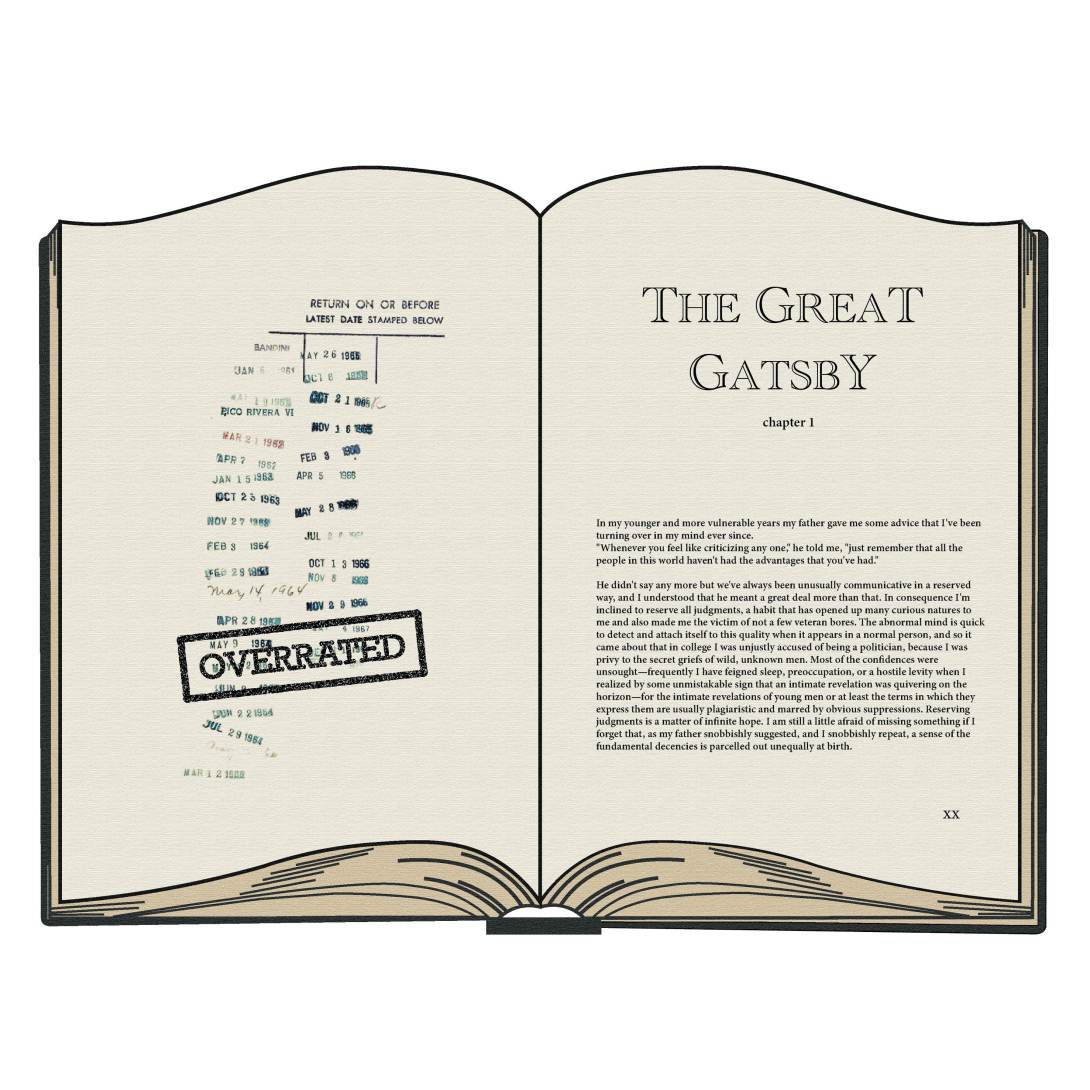
If these traits sound appealing to you, run! Don’t walk to your nearest independently owned, endearingly kitsch local bookshop (we’re not Amazon-supporting corrupt capitalists, cough Gatsby cough) to get your hands on a copy of F. Scott Fitzgerald’s 1925 industry-plant, ‘The Great Gatsby’.
This novel follows the unravelling of its titular character, Jay Gatsby, who is led astray by rose-tinted glasses so opaque it’s a wonder he doesn’t bump into his Rolls Royce thrice a chapter! Like many of his fellow contemporary cisgendered, White male protagonists of 20th century fiction, Gatsby has a one-track mind geared towards a goal that only benefits himself. The difference between this conceited wanna-be and the Winston Smiths (‘1984’), Willy Lomans (‘Death of a Salesman’), and Brick Pollitts (‘Cat on a Hot Tin Roof’) of his time is that they actually had something material at stake.
Most people with enough disposable income to own a juicer that spits out the nectar of four hundred oranges an hour—and a butler to operate it—might be satisfied with their status. Maybe his vitamin C levels were out of whack, but Gatsby was no individual to be satiated by endless wealth or unbridled access to cocktail fruits. Instead, day in, day out, this man dreams of… a green lamp. A green lamp symbolic of an ex-girlfriend, who symbolised a bygone era, that symbolised a lost identity, that symbolised… money, basically.
Fitzgerald’s (concededly) skilful and poetically evocative language materialises the same rose-tinted glasses upon the eyes of the reader. Though through more sobering lenses, such as the likes of T.J. Eckleburg’s, there is only so far romanticism can carry a tale of rich elites. Especially those who languish in their wealth so obliviously as to be driven to murder, madness and forty repetitions of “Old Sport”
 Esperanto Magazine