Words by: Ash Dowling
Art by: Sasha Clancy
My books are kept in a modest 3×3 cube bookshelf in my bedroom. I wish I could say it was organised so that each cube contained books of a particular genre, era, or even colour — but instead, they are all mixed up, like the surprising friendship groups that emerge in middle school.
Take for example cube two: we have a dictionary — the nerd, ‘Frankenstein’ — the goth, a Cadel Evans biography — the athlete, and a “Wellness Journal” — the girl with a lifestyle Instagram page. But I tend to be more organised with words than with possessions. So let me take you on a written tour of my bookshelf, (somewhat) neatly organised by genre, tucked between dust-free subheadings (and a few tangents).
Fiction
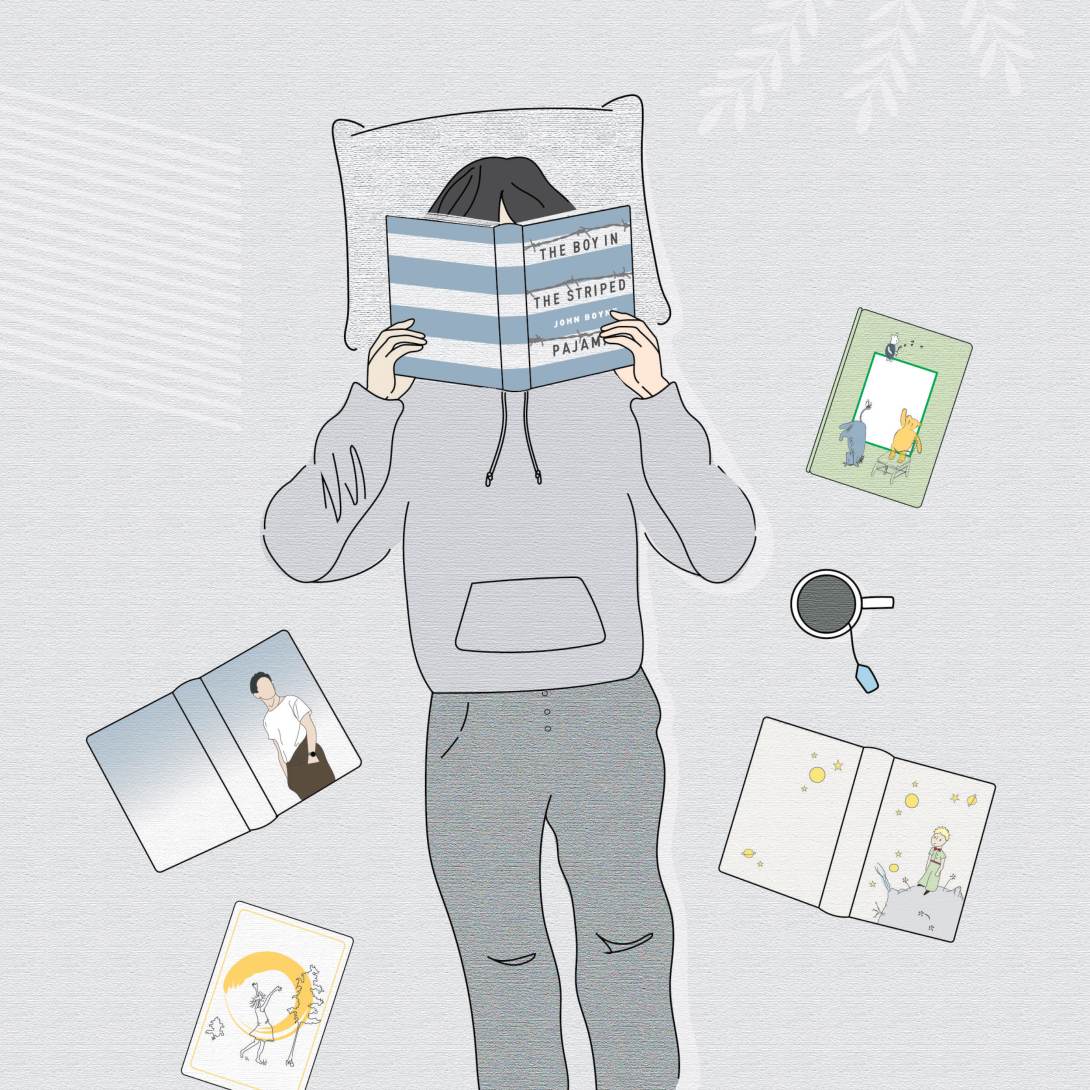
Moving left to right, the first fiction book you will see is ‘The Boy in the Striped Pyjamas’ by John Boyne. This book was gifted to me for my eleventh birthday by a friend who attended my pyjama-themed party and thought it was very fitting to get me a book with ‘pyjamas’ in the title. It was much later when I finally read the book, that I learned the titular pyjamas were referring to the mandatory striped uniforms worn by the Jewish prisoners during the Holocaust. Naturally, this made the book seem slightly less appropriate.
A much lighter read — well, until you think more deeply about it — is ‘Winnie the Pooh: Favourite Stories’ by A. A. Milne. I was given this book by my aunt years ago but it still continues to surprise me. It has been said that each main character represents a mental illness, an interpretation that brings out new layers of meaning from their whimsical tales.
Another whimsical tale that lends itself to allegorical analysis is ‘The Little Prince’ by Antoine de Saint-Exupery. On my shelf is the original French version, given to me as a parting gift by a friend I made while I was on exchange in England. One of the main themes of the book is the im- portance of relationships. This was a truth I was reminded of whilst on exchange where I had to build new friend- ships in a new country. To then be gifted this book by one of these friends was very special.
Autobiographies / biographies
I confess the shelves between genres in this written bookshelf tour are becoming blurred, as ‘The Little Prince’ is arguably a loose autobiography. I should have anticipated that some books would not easily fit into a box.
Although ‘Unbroken’ by Laura Hillenbrand is a pretty clear- cut biography, the life of her subject, a World War 2 pilot named Louis Zamperini, is at times so unbelievable this book could be mistaken for fiction. I would recommend this biography even to those who do not typically gravitate towards non-fiction, as it is such a powerful story of resilience and redemption.
Poetry
Is poetry a genre? Poetry can be fictional, biographical, autobiographical… perhaps it is better defined as a form rather than a genre. I fear this written bookshelf has collapsed. Nowadays, poetry books are my most frequent purchase. As an aspiring poet, I seek to expand my horizons as well as support poets I encounter in the Instagram poetry community.
One such poet was Eleana Norton @eleana.poetry, whose first book, ‘Little Dancers’, was published last year. It is a raw and beautiful collection of poems inspired by tragedies, victories, friendships and faith. I’d like to finish my ill-fated bookshelf tour with an excerpt from one of Eleana’s poems:
Finally
I am finding language to tell my story
Planted in the silence of untraveled mornings
…
Buried in the embrace of delicate nights
Over the years, books have helped me to find language to tell my story. Fictional or non-fictional, in poetry or prose, books can be powerful resources and teachers. I encourage you to consider your own bookshelves — however disorganised they may be — and reflect on what you have gained from the stories they hold.
 Esperanto Magazine