Words by: Fae Gehren
Artwork by: Ilanda Tran
Interviewee: Leeav (they/them)
I never knew what “right” felt like until now.
I felt trapped in every relationship I have been in. Like I was losing myself bit by bit. That is not a testament to the people I dated (well… maybe sometimes), but to the type of relationship I was in. For years polyamory has been ticking away in the back of my mind, because something about monogamy always felt wrong. Honestly, I felt like something was wrong with me.
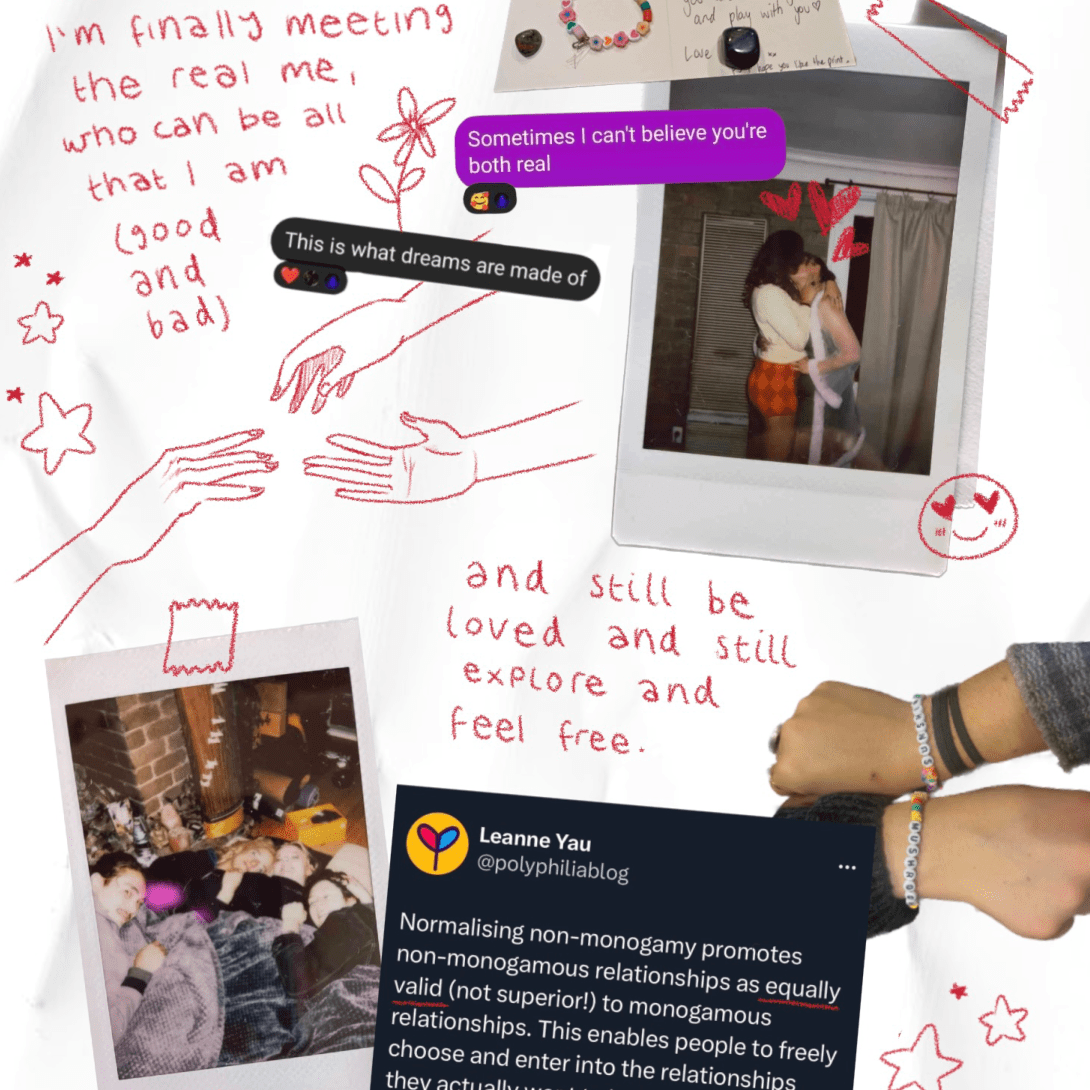
Finally, four months ago, I met a poly person for the first time. They sparked a light in my life I never believed possible. Suddenly, it felt like wings had been unbuckled to my back and I was ready to take the chance. Free fall into it. I’m so glad I did.
That person is now my girlfriend. And they have a Partner. We’re also seeing another wonderful, powerful woman. Together, and separately.
I am embarking on a new connection with another incredible woman I’ve been crushing on for almost a year. I feel as though the world is at my fingertips. I am finally getting to know the real me — the person I always was deep down. The person buried beneath the shame, pressure and confusion of a world that denied the way they were meant to love.
So, what is Polyamory?
I am polyamorous.
Cue the blank stares.
“But how does that work?”
“So like orgies and stuff?”
“I could never do that.”
It all means the same thing. They don’t understand. Not really. Because it’s not seen or heard about. And when it is, it’s often surrounded by stigma and shame.
SO LET’S DEBUNK SOME COMMON MYTHS:
“Is polyamory the same as polygamy?”
Polygamy refers to group marriages, usually one man with multiple wives. Polyamory is the practice of having multiple partners. Originally this was thought to refer to only romantic partners. But, many people choose to include creative, platonic or other types of partnerships in how they identify as poly.
There are also different types of polyamory and different ways of practising it. This includes solo polyamory, hierarchical or non-hierarchical, and many more. It is also different from an open relationship, which typically involves multiple sexual partners but remaining emotionally committed to only one person. Scan the QR code for a glossary of poly terms.
“Polyamory is abnormal.”
Polyamory is not presented as the norm. However, that does not mean it is abnormal, or against human nature. Rebecca Decynzski’s 2021 article, ‘A Brief History of Non-monogamy’, explains that this relationship style “dates all the way back to B.C.E. times”. However, our modern understanding of polyamory emerged from the Free Love Movement in the 1960s and ’70s.
From my experience, despite its lack of representation in mainstream society, the poly community is much bigger than you might think. Once you open yourself up to conversations about it, you end up meeting more and more like-minded people — whether they are practising, considering, or simply curious about polyamory.
“Polyamory is just about sex.”
This is, once again, absolutely not true. Polyamory is about so much more than sex. It can even be an avenue for asexual or aromantic identifying individuals to find a different type of connection that works for them, without sex or traditional romance.
Even though poly is about more than just sex, I want to stress that: sex being an important factor in relationships is not bad or shameful.
Poly presents ample opportunities to explore and seek pleasure, whilst simultaneously prioritising open communication and practising safe sex.
Take Leeav, for example. They are a Queer, Nonbinary, multimedia artist, who has been poly for over a year now. For them, polyamory has created a space for exploring different kinds of sex. They have discovered a deeper understanding of sex and intimacy as “mutually exclusive [and sometimes overlapping] entities.”
“I think what I have already experienced as an Enby [in polyamory] is opening myself up to different forms of intimacy.”
“Poly = group sex.”
Not everyone who practises polyamory likes or engages in group sex. Yes, some of us do, because it gives us opportunities to share intimacy and connection with more people. Not to mention, we get the rare chance to discover new pleasures and different ways of having sex that don’t necessarily include the typical ‘penis in vagina’ action. This can be especially liberating for gender diverse or LGBTQIA+ individuals.
“Polyamory is a fun, easy way to avoid commitment.”
Polyamory is by no means easy.
As Leeav puts it, “you’re giving yourself to many people rather than one in a standard monogamous way.”
“It can be fun and easy and cool. It can also be a lot of hard work…You need to be very self-aware. You need to be willing to have many difficult conversations with yourself and with your partner or partners.”
“You need to be in a place in your life where you’re able to deal with emotions such as jealousy, vulnerability, pain, and loneliness. I think people don’t understand that polyamory is actually quite lonely.”
So what can polyamory be?
It can be a way to explore your sexuality, or something to research and discuss but never try. It can be something to dabble in and never return to, whilst still taking away some new communication skills. It can be a way to face the deepest parts of yourself and learn from them. It might even be the only way love can feel right for you — like it is for me.
Really, poly can be whatever you want it to be. As long as you communicate openly and treat your partners with respect.
That’s the beauty of it—it’s a free fall into unbound love.
Use the QR code to explore my sources and other interesting resources to check out.

Note: This is based on the writer’s personal research and poly journey.
 Esperanto Magazine